The midterms reshaped the face of an institution dominated by older White men and often likened to a country club.
This article was written by Shefali Luthra, Grace Panetta and originally published on https://19thnews.org
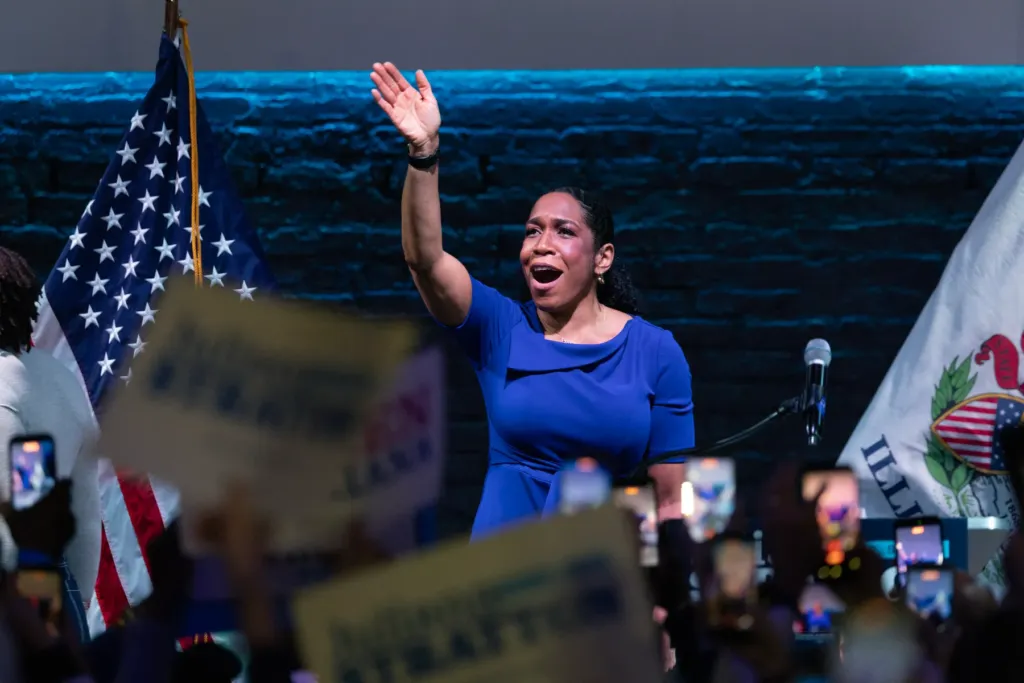
With her election to the Senate, Illinois Lt. Governor Juliana Stratton is the fifth Black woman ever elected to the U.S. Senate and this cements Illinois as the first state to have two women of color in the Senate at the same time.(Scott Olson/Getty Images)
More than 30 years ago, then-Illinois state Rep. Carol Moseley Braun became the first Black woman elected to the U.S. Senate in a watershed year for women candidates.
This year, another woman from Illinois — Lt. Gov. Juliana Stratton — made history again. Her win makes her the fifth Black woman ever elected to the U.S. Senate and cements Illinois as the first state to have two women of color in the Senate at the same time. Her win also guarantees that, for the first time in history, three Black women will serve simultaneously in the upper chamber. Decision Desk HQ projected that Angie Nixon, the Democratic nominee for Senate in Florida, will lose to incumbent Ashley Moody.
Stratton’s victory is part of a wave of projected Democratic victories that led to the party taking control of the Senate, a stunning rebuke of President Donald Trump’s second term thus far, cementing the party’s control of both chambers of Congress.
The switch means Democrats will have the power to block Trump’s nominees for Cabinet officials and federal judgeships. In an interview with Fox News late Tuesday night, Trump said he intended to rely on the presidential veto to block Democratic priorities.
Stratton recently told The 19th’s Errin Haines that running for Senate as a Black woman can be daunting — but that she relied on support from Sens. Angela Alsobrooks of Maryland and Lisa Blunt Rochester of Delaware, the two Black women serving in the upper chamber.
“What I knew is that in something so hard, I could get there and there would be two other women who fully understood what it was like,” Stratton said. “I knew that when it’s hard, there was somebody I could go to and say, ‘Where are we? How do we navigate this? What do we need to do? How can you help me?’ Because a lot of times, it’s Black women doing that for other Black women.”The election of Stratton, who will replace retiring Democratic Sen. Dick Durbin, demonstrates a legislative body that is slowly but surely becoming more diverse. Whether or not Democrats flip control of the chamber, this year’s elections will reshape the face of an institution historically dominated by older White men and often likened to a country club.
Women hold only 27 of the 100 seats in the Senate, and just 64 women have ever served since the chamber first convened in 1789, according to the Center for American Women and Politics. Of those senators, only five have been Black; Laphonza Butler was appointed to fill former Vice President Kamala Harris’ seat in 2021 but did not run for a full term. Only three Asian-American and Pacific Islander women (Harris, Sen. Tammy Duckworth of Illinois and Sen. Mazie Hirono of Hawaii) and one Latina, Sen. Catherine Cortez-Masto of Nevada, have served in the Senate; all are Democrats.
Stratton is just one of the Democratic Senate candidates to make history in 2026.
In New Hampshire, Decision Desk HQ projects that Rep. Chris Pappas will be the first out gay man to serve in the Senate.
Democrat Peggy Flanagan of Minnesota will make history as the first Native woman to serve in the Senate. Mary Peltola of Alaska could join her if she is also elected. In Michigan, Democrat Abdul El-Sayed will be the nation’s first Muslim senator after Decision Desk HQ projected him defeating Republican Mike Rogers.
Stratton and Pappas were part of a wave of early projections — including the reelection of Jon Ossoff, in Georgia — that led to Democrats being set to take control of the Senate. In North Carolina, former Gov. Roy Cooper, a Democrat, won his Senate bid, taking a seat that had previously been held by a Republican, Decision Desk HQ projected.
And in a stunning upset in ruby-red South Carolina, Democrat Annie Andrews unseated Republican Darline Graham, who had assumed the seat previously held by her brother, the late Sen. Lindsay Graham. Andrews is the first woman ever elected to represent South Carolina in the Senate. In Texas, which hasn’t elected a Democrat to statewide office in over 30 years, Decision Desk HQ projected that Democrat James Talarico replaced longtime Sen. John Cornyn, defeating Republican Ken Paxton in a race that hinged on questions of masculinity and anti-transgender attacks.
In Maine, Republican Sen. Susan Collins, who held the record as the longest-serving Republican woman senator, conceded to Democrat Troy Jackson, who emphasized Collins’ vote to confirm Supreme Court Justice Brett Kavanaugh throughout his campaign. Kavanaugh cast a deciding vote in the overturn of Roe v. Wade.
In Kansas, Decision Desk HQ projected megapastor Adam Hamilton to be the first Democrat elected to the Senate from the state since 1932, a stunning victory after a campaign that emphasized the stories of women who had been jailed after reportedly being sued over medical debts owed to his opponent, Republican Sen. Roger Marshall. In Ohio, Democrat Sherrod Brown defeated incumbent Sen. John Husted, and in Iowa, Democrat Josh Turek, a wheelchair user and former Paralympian, won against Republican Ashley Hinson, Decision Desk HQ projected. Turek will add to the ranks of senators with disabilities.
The number of women senators serving in the next Congress won’t be fully decided in November: Two women senators, Democratic Sen. Amy Klobuchar of Minnesota and Republican Sen. Marsha Blackburn of Tennessee, weren’t up for reelection this year but both successfully won ran for governor in their states. They will appoint successors to fill the rest of their terms.