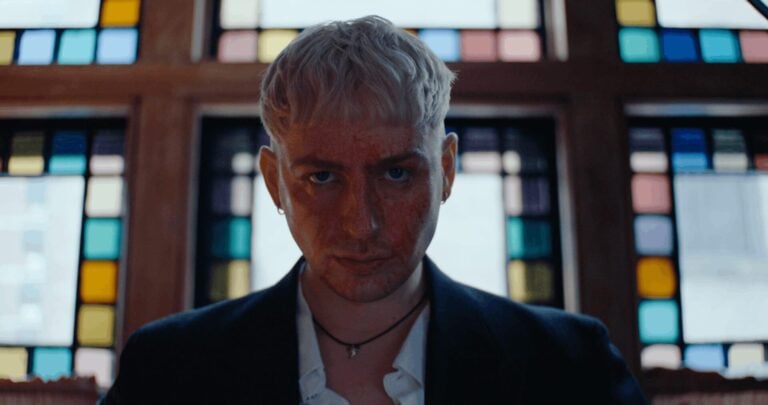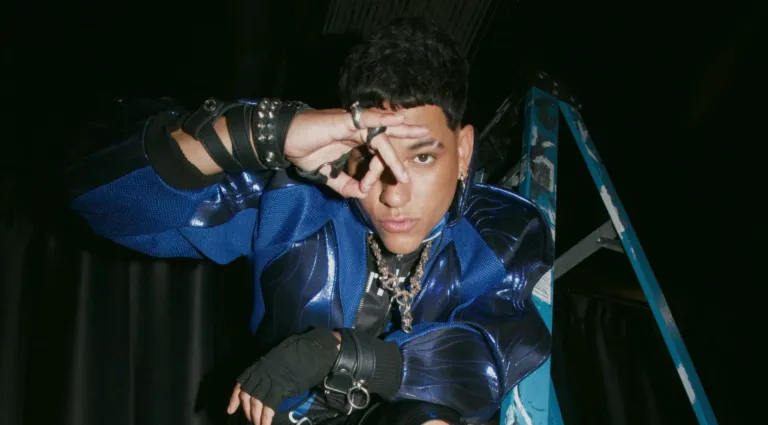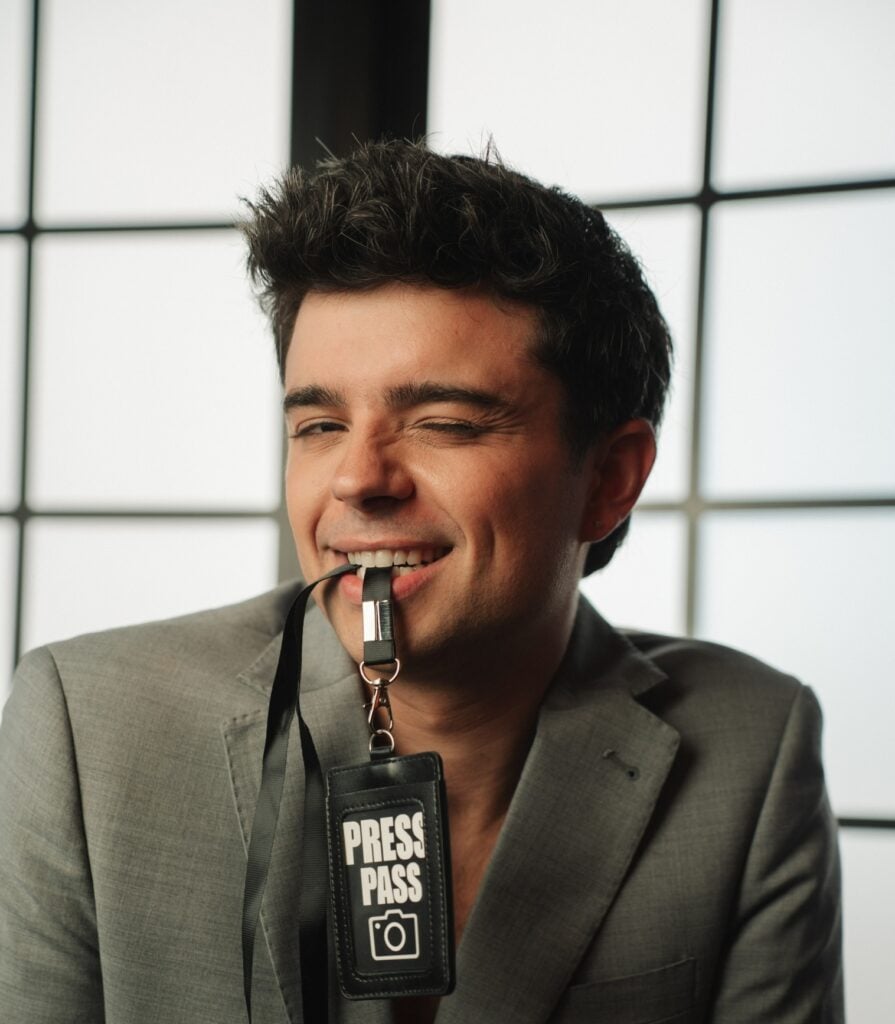
Thanks to his background in traditional news, Ford Sanders knows a thing or two about putting in long hours to chase a story. And now that he’s transitioned from journalist to social media star and podcast host, he’s thrilled he’s now being “worked to the bone” doing something he really loves.
Dubbing himself a “Former News Reporter. Current Icon,” 27-year-old Sanders got his start with on-air gigs in North Carolina, Kentucky, and Austin. While he dipped his toes into social media by first sharing clips from his news reports, he eventually turned that side hustle into a full time business.
Now, he boasts 191K followers on TikTok, and almost another 100K on Instagram, with his most viral video being viewed by more than 21 million people. In the past year, he also found himself a superstar manager and signed with WME, working with the talent agency to launch a brand new podcast.
In his bid to become your “gay internet bestie,” Breaking Down with Ford Sanders finds him putting his journalistic background to use, as he interviews his friends and other influencers, while also diving deep into the hottest news in pop culture.
Speaking with So.Gay after the podcast launch earlier this month, Sanders opened up about his social media journey so far, giving advice for other creators out there, revealing when he felt he’d made it as an influencer, and sharing his hopes for the future.
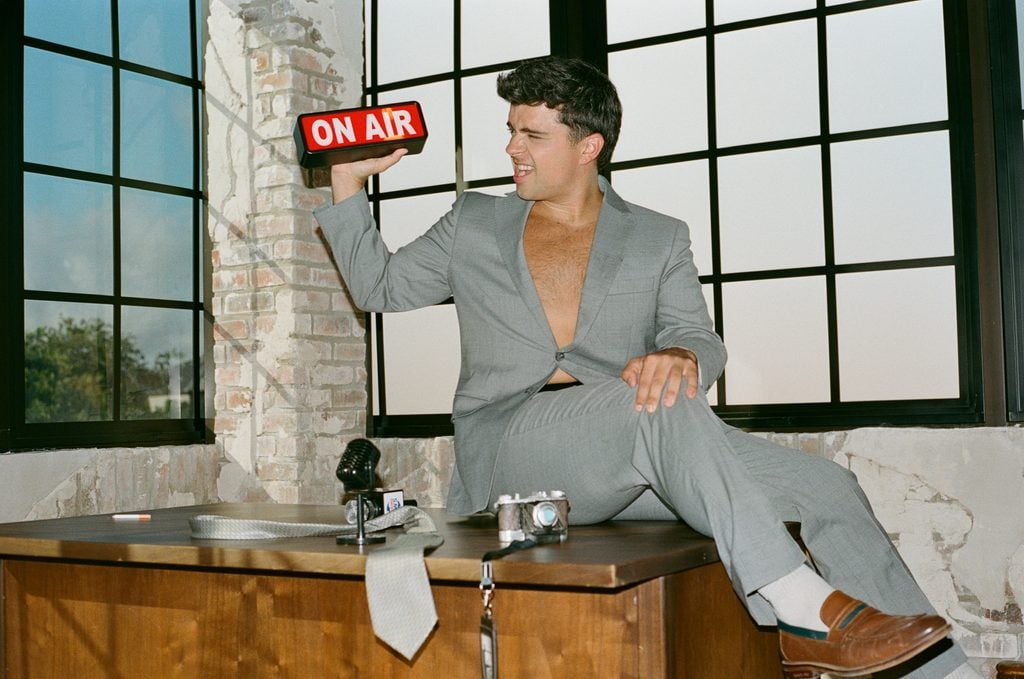
So.Gay: First of all, congrats on the podcast launch. I know it’s been a long time coming for you, but first, I want to take it back a little bit. I know you started in news, hopping around North Carolina, Kentucky, Austin, and then stepped away from TV to focus more on social media. Can you talk a little bit about how your social media following began while you were also juggling the reporter career?
Ford Sanders: Yeah, it’s crazy, like you said, I was in Greenville, North Carolina, Louisville, Kentucky, then Austin, Texas, and I feel like when I was in Louisville, I did one or two TikToks that were news-related. I don’t think people understand, but it’s a brand new story every single day on TV. You’re working 8 hours a day just to get a story up, and then you wash and repeat every day. It was so much work, and I was like, okay, respectfully, journalism’s going nowhere, but the medium is kind of dying down on cable. So I was like, let me put it on TikTok. So I did one or two in Louisville that did pretty well, and then I stopped. I was just like, okay, I’m literally lazy.
Then I moved to Austin, Texas. Some people get mad when we say this, but we say it’s kind of like baby LA, and so Austin, Texas is a very social-forward city. There were maybe one or two reporters kind of dabbling and doing their stories on TikTok and Instagram, and so I really took over and was like, I want to do this, I’m doing this all day, every day, let me just break it down to 90 seconds and see where it goes.
I would say the first 5 months. 200 views, 300 views, but in my head, I’m so delusional, I’m like, baby, that’s better than zero. My start on social media was basically doing strictly news stories, mostly Austin-based, so I was really local at the time. But it was breaking news, it was health news. Whatever I was doing for the day, I was just bringing back over to TikTok in a minute, minute and a half. And people really resonated with that, were scrolling all day, every day. I think it was easy for them to see a breakdown from a classically trained journalist that was also kind of like your BFF online. So I’d say a good year, year and a half, I was doing that on TikTok. So, yeah.
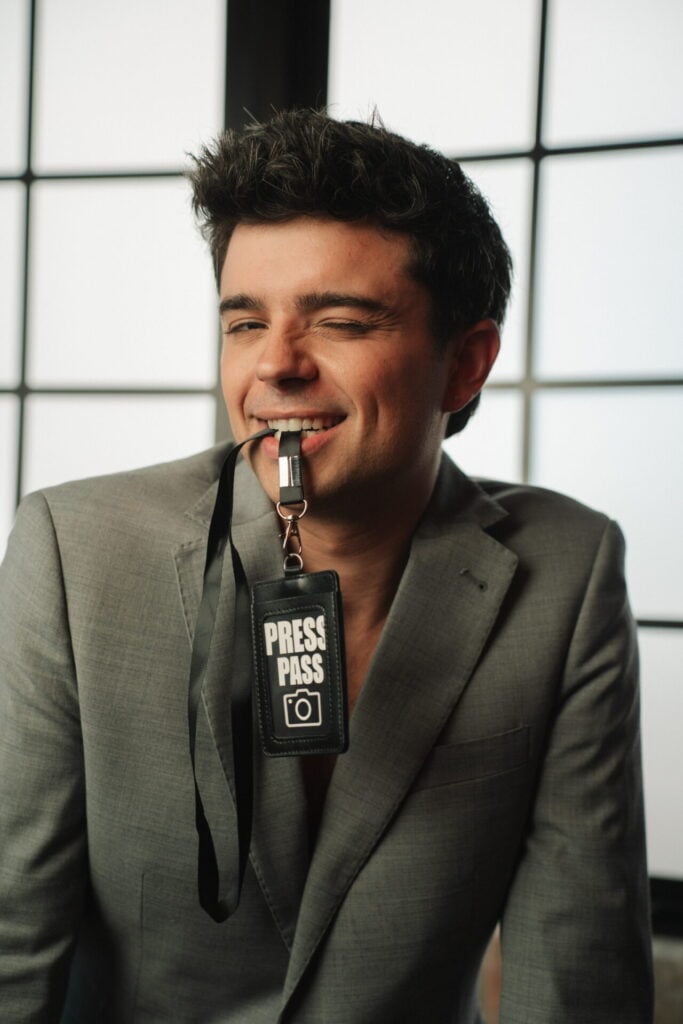
So.Gay: Okay. And what made you decide to do this pivot, to go full-time, and how stressful was it at first to go from having this steady job to something that’s a little more abstract?
Ford Sanders: Yeah, well, the internet’s convinced I was fired, which I was never fired, ever, ever, ever. It was sort of a situation where the pivot came from, okay, I want to show more of my personality. I think at the time, I had around 50,000 followers across TikTok and Instagram. And I was like, I want to show more of my personality, because I would have little videos where I would be with my friends or something like that that would do really well as well. So I’m like, okay, people actually care on both ends. And I think — no, I know — the news station was kind of like, pick a lane. They never explicitly said, “Don’t show your personality,” but it was kind of like, “You’re a journalist, and we’re still going by the old playbook, and this is how it’s gonna be.”
And so I kind of made that decision to step away. Yeah, it was very scary. I think what people don’t realize, and I’ve talked about this on my podcast, but my first job in North Carolina, I made $30,000, so I made like $26K after taxes. In Austin, I made less than double that, so it was good money, but Austin’s expensive. So, yes, it’s a stable job and a stable paycheck. But I was like, I know I can make it happen.
So I was still doing news, but I wasn’t getting the most brand deals, because it’s hard when you’re talking about breaking news or, unfortunately, like a mass shooting. And so I was like, let me really focus on getting my personality up, and then that’s when the pivot kind of came. I would say November of last year is when I started doing my new series, and that’s when things just really shifted.
So.Gay: You’ve also been very open about your fitness journey. Do you think that played a role in your rising platform? I think it helped showing how transparent you are, and people getting a real feel of who you are, your personality.
Ford Sanders: That whole transformation was my first series outside of news that I dipped my feet in to show this is me. I’m making something about me now. And I have people to this day saying that I helped inspire them to lose 70 pounds, 80 pounds, even 10 pounds. To me, that’s insane. I would say that definitely gave me a boost, because I started seeing brand deals from wellness companies like Bloom, wellness nutrition companies, and I was like, okay, so obviously it’s resonating with an audience.
But I also think my transparency was really helpful in that. I did all the hard work, but I’m very clear I was on GLP-1s, but I was working out twice a day. I got liposuction 3 times. And people would be like, “Well, you lost all that weight through lipo.” We know lipo’s not a weight loss surgery, I came out heavier from lipo. It was very interesting for me, because I was like, if I’m gonna do something about me and talk about my weight loss journey, I’m not hiding a single bit of it.
So, I think that, honestly, where there were bumps, where people would kind of be like, “Okay, well, you did this, you did that, you didn’t actually lose the weight,” the overwhelming aspect was just people being like, “You inspired me to do this,” or, “How was your surgery? I’m insecure about this, did it help tighten up your skin?” So, I was really grateful that I decided to just lay it all out on the table.
So.Gay: When did you feel like you had made it? That this decision was the right one, it was paying off?
Ford Sanders: Honestly, not till March of this year. I started doing—and shout out to, I always give him credit, Landan Ash, he’s a creator as well, and he did this one thing where he was like, “As a gay, you can walk in the room and say whatever.” And I was like, that is so true. And so I did this one thing where I just walked into a room and said, “How much wood could a woodchuck chuck?” And it got, like, across platforms, I would say 60 million views in two weeks, and then I was like, I’m not stopping, so I would do all these different little idioms and nursery rhymes, and it was getting 20 million, 30 million, 10 million.
So, I think March was big for me. However, I kind of mentioned back in November of 2025 is when I felt like I fully stopped doing news. I stopped doing news almost all together. I have a bunch of straight friends here in Austin. I did this thing where I’m like, “Me flirting with my straight friends in public, because what are they gonna do about it?” Because they’re all respectful kings, so it made for really good content. And so I started doing that, and that’s what started to blow up.
My manager Lauryn over at Strand Entertainment found me at the beginning of March, and this was before I ever did a “Gay Walk in the Room” video. So that’s how I know she’s a real one, because she found before my true viral moment. So, I think March for me was the most pivotal because I had signed with her, and then a week and a half later, had my most viral video ever, and then one month after, we signed with WME, which is one of the top four agencies. That March to April, I was like, okay, I can do this now, I feel comfortable.
I still had corporate clients, like, random financial firms here in Austin that I was doing their social media for, and I’m not opposed to going back. I love the freelance work, but now I’m finally in that era of, okay, this is full-time. It took a year and a half after I left the news, so I kind of went that whole year and a half not very confident. I was like, my bills need to be paid. I need to find a sugar daddy. I’m like, we gotta figure this out!
So.Gay: And can you talk just a little bit about finding representation, especially in a market that can be so saturated with influencers and content creators?
Ford Sanders: I’ve only had one other manager, who I still love to this day. When I left the news, I had about 50, 60,000 followers, and my manager had signed me. And we had each other for about a year. But I think at the time, I was doing deals that were still in the thousands of dollars, but lower thousands of dollars, and so they were enough to just cover my bills. Which I was so grateful for, and so she just didn’t feel great taking 20% out. She was like, “You’re killing it, you don’t need me,” so we left on great terms.
I have a lot of creators reach out to me now that have 5,000 followers, 10,000 followers on Instagram, which is so influential, honestly. People don’t realize how influential these micro-creators are, but I don’t think you need management right away. I think you should keep that full 20%, because the deals aren’t going from $2,000 to $15,000 with management representation. Once you get to a bigger level, they can start to double, triple your deals, and that’s when it’s worth it. All that to say, I waited. I waited and waited and waited. I had my manager, my current manager, reach out to me, and it just felt right.
She, you know, has some clients that are on Dancing with the Stars, she has clients that are in major films and TV shows, and I was like, this is great for me, because I want to branch out. I have this television news background. Who says I wouldn’t want to do maybe a TV slot one day, or the podcast which came to fruition with them, thankfully. I think with management, it’s best to be picky.
So.Gay: And then, when did you start thinking about entering the world of podcasting?
Influencer to podcast host does seem like the pipeline, but how did you figure out what your podcast was going to be and how you would stand out in the market?
Ford Sanders: There’s that pipeline we see, influencer to podcast, all of that, and I always thought, why not? Content is really hard, honestly. Like, it’s really easy, it’s such a blessing of a job, but it can be really taxing. But I just knew if I’m doing this all day anyways, and you’re on your phone, and you’re making these Reels, you’re making these TikToks, why not diversify it? To me, it felt like a disservice to leave my classical training as a journalist, where I was doing packages and anchoring the news, where I could turn a full story every single day, why would I not give myself a full week to do a podcast? That’s easy money.
I know a lot of influencers have podcasts, but I knew that I could bring something else to this market. We have a lot of people, like, Trisha Paytas is one of the people I actually look up to a lot when it comes to podcasting. She does pop culture breakdowns and things like that. I knew I wanted to do that, and I was very excited to do that because, yeah, I used to do the breaking news, but I know I can break down pop culture news and kind of be your gay internet bestie, but also I have the chops, I have the classical journalist training.
So, podcasting to me was just very much the next step, and I’m really happy to see it doing very well. We’re two episodes in. I just interviewed my best friend in this whole world, Austin, who’s also recently come out as gay. And I think that also ties back into, when my manager and I brought on WME a month later, I have this huge agency. I mean, they have Kim K., Billie Eilish, Olivia Rodrigo, they have all these people, and I’m like, okay, let’s take advantage of that. They wanted me, so I want them to do stuff back, and that’s where podcasting just fit in so perfectly. So, to me, it was just the normal route. I always knew I wanted to do it, but never let it get off the ground. It’s been really fun. I really, really have enjoyed having a full plate again.
So.Gay: And what has the feedback been like now that you have these first couple episodes out?
Ford Sanders: It’s so funny how the internet works, because the feedback on the first two episodes have been overwhelmingly just amazing. I’m getting hundreds of DMs about Austin’s episode, my first episode, but it’s also funny, because then we all know the world of podcasting is you get clips out of it. You get clips to go on social media that are supposed to be the shocking points of the episode. I have these clips that are doing 60,000, 70,000, 100,000 views, and being like, “Who said y’all need a podcast?,” “Why do you have a mic?”
It’s really conflicting, and I love that. I love to see that you’ve got this aspect on the internet where they’re just seeing a 60-second clip, and they’re like, “I hate y’all,” but then you have people watching the full episode, being like, “I needed to hear this.”
I had a guy the other day, and I posted it on my story from Tunisia, and he said, his words, that it’s just not the best to be out and about there, and he says it feels like a space for him to kind of escape and feel like he can be himself internally, externally, as he’s watching. Same with someone from Saudi Arabia who just commented this the other day, too. To me, the podcast is always going to be a passion project, no matter how big it gets. So I love just hearing those types of things. I think what’s helpful is doing social media before. I know how to handle hate comments, comments of love, things like that. So a podcast, it’s nothing new for me to hear conflicting [feedback].
So.Gay: Is it those comments of love that help you move past the opposite reactions?
Ford Sanders: I don’t know if you’ve heard of this, but I’m also from Nashville, Tennessee, the deep South, and so we have the dumbest phrases. But there’s a phrase that’s like, “If you had $100 and someone stole a quarter from you, are you gonna let that 25 cents ruin your whole day?” No, and I think about it like that. When you’re looking at these comments, I would say 90% across not just my podcast, but also my platforms, is people honestly loving and supporting.
It’s so important to focus on that, because it’s really easy — and I have been a victim of this — to fall into the trap of, okay, cool, that 5% to 10%, that’s not the nicest, I’m making a video about it, highlighting it, responding to it. You’ve got to remember, there’s so much more love out there.
So.Gay: Good. I know the first episode, you just mentioned, you had one your besties on. What can we expect from you, guest wise, going forward? What kind of things are you hoping to explore more?
Ford Sanders: I have filmed another episode with a mega influencer. She’s one of my best friends. I have another one coming up with another mega influencer. I just have a lot of really big, influential people that people are really wondering about. And these are my best friends, and so I was like, what better way than me do it? Because at the end of the day, and I think Austin’s episode was a really good example of that, I’m not holding back. I’m asking you about things that people have wondered about on the internet.
Like, Austin is in the most loving relationship right now, but for example, he had a high-profile ex that we talked about and alluded to. I’m gonna ask these questions. Guest wise, that’s what you can expect.
I basically do one guest out of the month, and we have four episodes. So three of the episodes are mostly going to be me, I might bring in a guest host, which is one of my friends, and we’re breaking down pop culture, but we’re doing the fact-checking, we’re making sure it’s accurate. That’s where I go back to your gay, Gen Z bestie, but with the chops of a classically trained journalist.
On top of that, I’m doing the first half as pop culture, second half is always gonna be personal life. People same to care, so let’s talk about it. I just had this thing where someone is pretending to be me in real life. I’ve clipped, it’s gone on the internet, people would be like, “Yes, I literally met this person and realized it wasn’t you.” I don’t know how that’s happening, but I have an imposter. So anyways, it’s things like that. My life is so chaotic, beyond, and that’s where the name Breaking Down comes from. I’m breaking down the news, I’m breaking down my own life, but I’m also a dramatic gay that could literally have a breakdown any second. They can expect breakdowns, chaos, guests, and all love.
So.Gay: Dream guest, who would it be?
Ford Sanders: I’ll give a two-part answer to this. This is so crazy to say but my dream guests really are the friends that I have coming on and coming up. These are huge influencers, but they’re my friends off of social media, and I love being able to have that access to them. And make them feel comfortable.
But if we want to talk about dream guests, let’s do dead or alive. If it was someone dead, my dream guest would be Joan Rivers. Joan Rivers would have been my number one go-to guest. I love her, I love her, I love her.
I would say someone I really want to get on there is Summer Walker. She’s an R&B artist. She’s been my number one artist for, god, 7 years in a row now, and I like her because she’s pretty reserved, and so I want to dig deeper. I feel like I’m a superfan, so I know a lot about her.
So.Gay: It will manifest at least Summer Walker for you, can’t help you out with Joan.
Ford Sanders: I’ll get a medium.
So.Gay: That would actually probably be a fun episode, too, though! And last question I have for you is, just looking ahead, what do you think this next chapter looks like? Where do you want to go from here?
Ford Sanders: I told my team I want to be worked to the bone. To be honest with you, news was such a demanding job, getting up at 2 in the morning, or staying out on a breaking news scene till 3 in the morning, working nearly what seems like a 24-hour shift.
I don’t want to ever break down content creators and say this isn’t a hard job. It is difficult. You’re constantly on your phone, which gives me anxiety in general. You’re constantly editing, and now having the podcast, you’re doing long form. But I tell my team, I feel really blessed, because all of this work still feels like half of the intensity on my mental health and body than it was with news.
So I’m like, keep going. So I think this next chapter is being worked to the bone, but not in a negative aspect, because this is my dream job and everything. So I want to be worked.
Also, reality show. That’s what we want. We’ve been talking to casting producers, things might be in the works. Until I see a pilot being filmed and it being pitched out, cool, but I have some really, really good friends here that, I mean, honey, it’s like, we’re throwing drinks on each other without the camera. So, I’m like, bring it, like, bring the cameras, we’re ready for this. The future for me is diversified in different forms of media, so I’m excited to see where that goes.