Building a bigger chest is one of the most common goals for men who train with weights, and for good reason. A well-developed set of pecs changes the way you look in a t-shirt, improves your pressing strength across every plane of motion, and contributes to a balanced, athletic physique. But here’s the thing: most guys spend years hammering away at the flat bench press without much to show for it. The problem usually isn’t effort. It’s a lack of understanding about how the chest muscles actually work, which exercises produce the most growth, and how training variables like volume, intensity, and recovery fit together. If you’ve been searching for the best ways to get bigger pec muscles as a man, you’re probably tired of generic advice. This guide breaks down the anatomy, the movements, the programming, and the nutrition you need to actually make your chest grow. No fluff, no bro-science: just what works based on exercise science and real-world results.

Anatomy and Mechanics of the Pectoral Muscles
Understanding how your chest muscles are structured is the first step toward training them effectively. Too many lifters treat the chest as a single slab of muscle, which leads to imbalanced development and wasted sets.
Targeting the Pectoralis Major and Minor
The pectoralis major is the large, fan-shaped muscle that covers the front of your upper chest. It’s responsible for horizontal adduction (bringing your arm across your body), internal rotation, and flexion of the shoulder joint. This is the muscle you’re primarily trying to grow when you train chest.
Underneath it sits the pectoralis minor, a smaller, triangular muscle that attaches from the third, fourth, and fifth ribs to the scapula. The pec minor doesn’t contribute much to the visible size of your chest, but it plays a critical role in scapular stability. A tight or underdeveloped pec minor can pull your shoulders forward and limit your range of motion on pressing movements, so it’s worth paying attention to even if it’s not the star of the show.
The Role of Upper, Mid, and Lower Chest Fibers
The pectoralis major isn’t a single uniform sheet. Its fibers run in different directions depending on where they originate. The clavicular head (upper chest) originates from the collarbone and runs downward to the humerus. The sternal head (mid and lower chest) originates from the sternum and the upper abdominal fascia, with fibers running more horizontally and even slightly upward.
This fiber orientation matters because it determines which exercises emphasize which regions. Incline pressing preferentially recruits the clavicular fibers. Flat pressing hits the sternal head hard. Decline movements and dips shift emphasis to the lower fibers. If you want a chest that looks full from every angle, you need to train across all three planes. Ignoring the upper chest, which most guys do, is the number one reason men end up with a chest that looks thick from the side but flat near the collarbones.
Core Compound Movements for Maximum Mass
Compound pressing movements are the foundation of any effective chest-building program. They allow you to move heavy loads through a large range of motion, which is exactly what triggers the mechanical tension needed for hypertrophy.
Mastering the Barbell and Dumbbell Bench Press
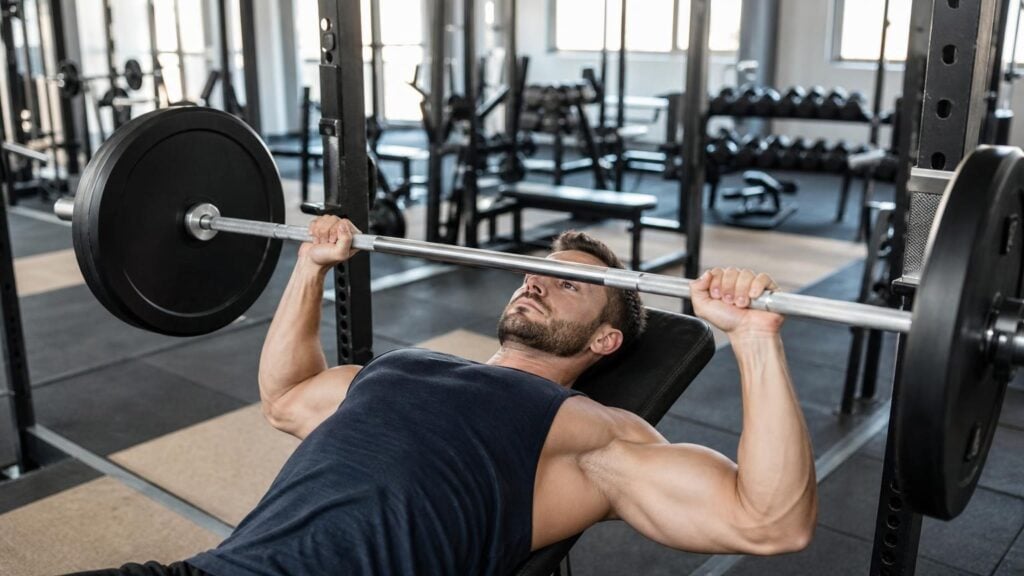
The flat barbell bench press remains one of the most effective chest exercises available. It lets you load the pectoralis major with significant weight, and it’s easy to progressively overload week to week. But form matters more than most people realize. Retract and depress your shoulder blades before you unrack the bar, keep a slight arch in your upper back, and lower the bar to your lower sternum with your elbows at roughly 45 to 75 degrees from your torso. Flaring your elbows out to 90 degrees shifts stress to the shoulder joint and increases injury risk.
Dumbbell bench pressing offers something the barbell can’t: a greater range of motion and independent loading of each arm. Research published in the Journal of Strength and Conditioning Research has consistently shown that dumbbells produce comparable or even superior pec activation compared to barbells, partly because you can bring the weights together at the top for a stronger contraction. Use both variations in your program. Barbells for heavy loading, dumbbells for stretch and activation.
Utilizing Incline Presses for Upper Chest Volume
Setting the bench to a 30 to 45 degree incline shifts the emphasis to the clavicular head of the pec major. A 2020 study in the International Journal of Environmental Research and Public Health found that a 30-degree incline produced the highest upper chest EMG activation without excessively recruiting the anterior deltoid. Going steeper than 45 degrees turns the exercise into more of a shoulder press.
Aim for 3 to 4 sets of 8 to 12 reps with a controlled eccentric (lowering phase) of about 2 to 3 seconds. The upper chest tends to be stubborn for most men, so placing incline work first in your session, when you’re freshest, can make a real difference over time.
Weighted Dips for Lower Pec Development
Dips are an underrated chest builder. When performed with a forward lean and a wider grip, they place enormous stretch on the lower pec fibers at the bottom of the movement. This loaded stretch is a potent stimulus for muscle growth.
Start with bodyweight dips if you can’t yet perform 3 sets of 10 with clean form. Once you can, add weight using a dip belt or by holding a dumbbell between your feet. The key is to lean your torso forward at about 30 degrees and lower yourself until your upper arms are at least parallel to the floor. If you stay upright, you’ll turn dips into a tricep-dominant exercise. The forward lean is what makes this a chest movement.

Isolation Exercises to Sculpt and Define
Compound presses build the bulk of your chest mass, but isolation movements let you target the pecs with minimal tricep and shoulder involvement. This means more direct tension on the muscle fibers you’re trying to grow.
Cable Flyes and Cross-overs for Constant Tension
The biggest advantage cables have over dumbbells for flye variations is the resistance curve. With dumbbell flyes, tension drops off at the top of the movement because gravity pulls straight down. Cables keep tension on the pecs throughout the entire range of motion, including at peak contraction when your hands are together in front of your chest.
Set the pulleys high for a downward arc that emphasizes the lower chest, at shoulder height for the mid chest, or low for the upper chest. Use a controlled tempo, squeezing hard at the peak contraction for 1 to 2 seconds. Keep your elbows slightly bent but locked in position: this is a shoulder joint movement, not an elbow joint movement. Three to four sets of 12 to 15 reps works well here, as isolation exercises tend to respond better to moderate-to-high rep ranges.
The Benefits of the Pec Deck Machine
The pec deck gets dismissed by experienced lifters as a “beginner machine,” but that dismissal is misguided. The fixed path of motion eliminates the stabilization demands that can limit how much tension actually reaches your pecs during free-weight flyes. This makes the pec deck excellent for accumulating high-quality volume without fatiguing your rotator cuff or overtaxing your shoulders.
It’s also a great tool for mind-muscle connection work. Slow down the rep, pause at full contraction, and focus on feeling the chest fibers shorten. A 2012 study in the Journal of Strength and Conditioning Research showed that subjects who focused on “squeezing the target muscle” during an exercise experienced greater activation of that muscle. The pec deck is an ideal exercise for practicing this skill.
Advanced Training Techniques for Hypertrophy
Once you’ve built a solid foundation with compound and isolation movements, applying specific training techniques can push your chest growth past plateaus. These methods manipulate the primary drivers of hypertrophy: mechanical tension, metabolic stress, and muscle damage.
Implementing Progressive Overload and Time Under Tension
Progressive overload is non-negotiable. If you’re pressing the same weight for the same reps month after month, your chest has no reason to grow. Track your lifts and aim to increase either the weight, the reps, or the number of sets over time. Even small jumps matter. Adding 2.5 pounds to your bench press every two weeks translates to 65 pounds over a year.
Time under tension (TUT) is another variable worth manipulating. Slowing down the eccentric portion of your lifts to 3 to 4 seconds per rep increases the total duration your muscle fibers spend under load. A set of 10 reps with a 4-second eccentric gives you 40-plus seconds of tension, which falls squarely in the hypertrophy-friendly range. You don’t need to use this on every set, but applying it to your final 1 to 2 sets of each exercise can be a powerful growth stimulus.
Using Drop Sets and Supersets for Metabolic Stress
Drop sets involve performing a set to near-failure, immediately reducing the weight by 20 to 30 percent, and continuing for additional reps. This extends the set beyond what you could achieve with a single load and floods the muscle with metabolites like lactate, which signals growth through metabolic stress pathways.
Supersets pair two exercises back-to-back with no rest. A particularly effective chest superset is pairing a heavy compound press (like barbell bench) with a lighter isolation movement (like cable flyes). The press fatigues the chest under heavy load, and the flye finishes the job with targeted tension. Limit these techniques to the end of your workout: using them too early will compromise your performance on the heavy lifts that drive the majority of your gains.
Nutritional Strategies for Muscle Growth
Training provides the stimulus, but food provides the raw materials. You will not build bigger pecs, or bigger anything, without the right nutritional inputs. This is where a surprising number of dedicated lifters fall short.
Calculating Caloric Surplus and Protein Requirements
To build muscle, you need to eat more calories than you burn. A surplus of 250 to 500 calories per day above your maintenance level is the sweet spot for most men: large enough to support muscle growth, small enough to minimize unnecessary fat gain. You can estimate your maintenance calories by multiplying your body weight in pounds by 14 to 16, depending on your activity level.
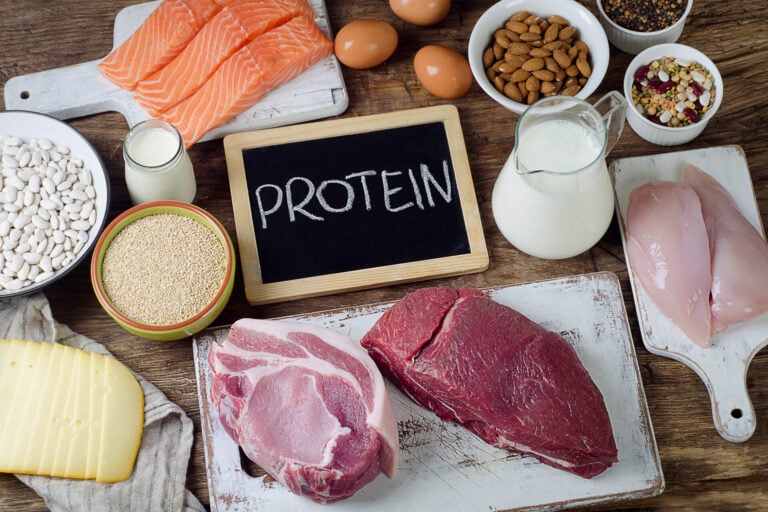
Protein is the most critical macronutrient for muscle growth. Current evidence, including a comprehensive 2022 meta-analysis in the British Journal of Sports Medicine, supports a daily intake of 1.6 to 2.2 grams of protein per kilogram of body weight for maximizing muscle protein synthesis. For a 180-pound (82 kg) man, that’s roughly 130 to 180 grams of protein per day. Spread this across 4 to 5 meals to keep amino acid availability elevated throughout the day. Good sources include chicken, beef, fish, eggs, Greek yogurt, and whey protein.
Don’t neglect carbohydrates, either. Carbs fuel your training sessions and replenish glycogen stores in your muscles. A man training hard 4 to 5 days per week should aim for at least 2 to 3 grams of carbs per kilogram of body weight daily.

Optimizing Recovery and Preventing Injury
Your chest doesn’t grow during your workout. It grows during the 48 to 72 hours afterward, when your body repairs damaged muscle fibers and lays down new tissue. Neglecting recovery is like building a house and tearing it down every weekend before the foundation sets.
The Importance of Rest Days and Sleep Quality
Most men can train chest directly twice per week with good results, provided they allow at least 48 hours between sessions. Training the same muscle group three or more times per week can work for some individuals, but only if per-session volume is kept low. A total weekly volume of 12 to 20 hard sets for chest is a solid target for intermediate to advanced lifters.
Sleep is arguably the most underrated growth factor. Growth hormone release peaks during deep sleep, and testosterone levels, which directly influence muscle protein synthesis, are closely tied to sleep duration. A 2011 study in the Journal of the American Medical Association found that men who slept only 5 hours per night for one week experienced a 10 to 15 percent reduction in testosterone levels. Aim for 7 to 9 hours of quality sleep per night. If you’re training hard and eating right but still not growing, poor sleep is often the missing piece.
Shoulder Mobility and Scapular Retraction Basics
Shoulder injuries are the most common training-related setback for men who prioritize chest work. The fix is almost always better scapular mechanics and improved shoulder mobility.
Before every pressing session, spend 5 minutes on thoracic spine extensions, band pull-aparts, and external rotation drills. These movements warm up the rotator cuff and reinforce proper scapular positioning. During your presses, always retract and depress your shoulder blades: think about pinching a pencil between them and driving them down toward your back pockets. This creates a stable base, protects your shoulder joint, and actually improves pec activation by putting the chest in a more mechanically advantageous position.
If you experience pinching or pain at the front of your shoulder during bench pressing, it’s usually a sign that your shoulders are rolling forward. Reduce the weight, fix your scapular position, and consider temporarily replacing barbell bench with dumbbell work, which allows your shoulders to move more freely.
Building a Chest That Lasts
Growing bigger pecs comes down to a handful of principles applied consistently over months and years. Train across multiple angles with compound presses, finish with targeted isolation work, eat enough protein and calories to fuel growth, and prioritize recovery like it’s part of your program, because it is.
The best approach to building bigger pec muscles for men isn’t about finding one magic exercise or secret technique. It’s about intelligent programming, progressive overload, and patience. Pick 4 to 5 chest exercises that cover the upper, mid, and lower fibers. Train them twice per week with 12 to 20 total hard sets. Eat in a slight surplus with 1.6 to 2.2 grams of protein per kilogram of body weight. Sleep 7 to 9 hours. Do this for 6 months and your chest will look noticeably different.
Start your next chest session with one change from this article. Retract your scapulae properly, add an incline variation, slow down your eccentric tempo: pick one thing and own it. Small, consistent improvements compound into results that no shortcut can match.