Most guys spend years training chest, arms, and shoulders without giving their glutes a second thought. Then one day they catch a side profile in the mirror and realize their backside is flat as a cutting board. Whether you’re chasing aesthetics, athletic performance, or just want your jeans to fit better, building a bigger butt as a man is entirely achievable with the right approach. The catch? It requires more than casually tossing a few sets of squats into leg day. The best ways for men to build a bigger butt involve strategic exercise selection, proper nutrition, and consistent progressive training. Most guys who fail at glute development aren’t lazy: they’re just doing the wrong things. This guide breaks down exactly what works, from anatomy to meal planning, so you can stop guessing and start growing.
Understanding Glute Anatomy and Muscle Growth for Men
Your glutes are the largest muscle group in your body, and understanding how they’re structured will change the way you train them. Too many lifters treat the glutes as a single slab of muscle when they’re actually three distinct muscles, each with different functions and activation patterns. Knowing the difference is the first step toward training them effectively.
The Role of the Gluteus Maximus, Medius, and Minimus
The gluteus maximus is the big one: it’s the primary driver of hip extension, meaning it fires hardest when you push your hips forward from a bent position. Think deadlifts, hip thrusts, and the standing portion of a squat. This muscle makes up the bulk of your backside and is responsible for most of the size you’re trying to build.
The gluteus medius sits on the upper-outer portion of your hip. Its main job is hip abduction (moving your leg away from your body) and stabilizing your pelvis during single-leg movements. The gluteus minimus, tucked beneath the medius, assists with similar stabilization tasks. While neither of these smaller muscles will add dramatic size on their own, developing them creates that rounded, three-dimensional look rather than a flat pancake shape.
Why Men Struggle with Glute Development
Men tend to be quad-dominant. Years of sitting at desks, combined with a natural tendency to push through the quads during squats and lunges, means the glutes often go underrecruited even during exercises that should target them. Testosterone gives men an advantage for overall muscle growth, but it doesn’t automatically direct that growth to the glutes.
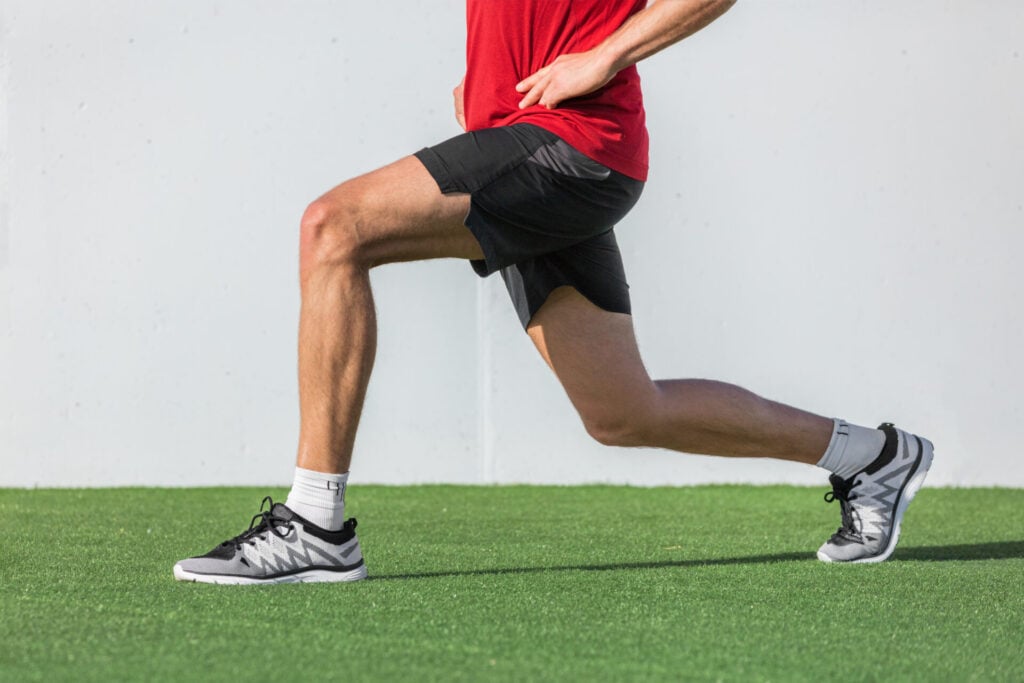
Another common issue is ego lifting. Guys load up the squat bar with weight they can’t handle through a full range of motion, cutting depth short and turning every set into a quad exercise. Half squats build half a physique. If you’ve been squatting heavy for years and your glutes haven’t grown, depth and mind-muscle connection are almost certainly the problem, not effort.
Essential Compound Exercises for Maximum Mass
Compound movements are the backbone of any serious glute-building program. These multi-joint exercises let you move heavy weight through large ranges of motion, creating the mechanical tension and metabolic stress that drive hypertrophy. If you’re only going to do three exercises for your glutes, make them these.
Mastering the Barbell Hip Thrust
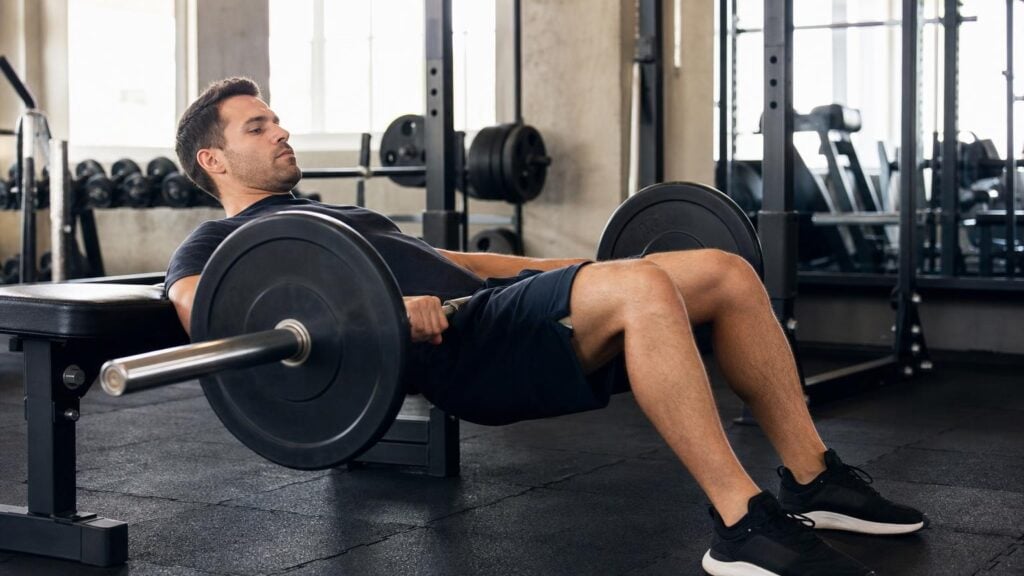
The barbell hip thrust is arguably the single most effective glute exercise available. Research from Bret Contreras (often called “The Glute Guy”) has consistently shown that hip thrusts produce higher glute activation than squats or deadlifts when performed correctly. The key is setup and execution.
Here’s how to do it right:
- Sit on the floor with your upper back against a flat bench, knees bent, feet flat on the ground about shoulder-width apart
- Roll a loaded barbell over your legs until it sits in the crease of your hips (use a bar pad or folded towel)
- Drive through your heels, squeezing your glutes hard at the top until your torso is parallel to the floor
- Hold the top position for a full second before lowering under control
Most men can work up to 1.5 to 2 times their bodyweight on hip thrusts within a year of consistent training. Start with 3 sets of 10 to 12 reps, and focus on a hard squeeze at lockout rather than bouncing the weight.
Deep Squat Variations for Glute Activation
Squats are a staple, but how you squat determines whether your glutes or quads do the heavy lifting. Deep squats (below parallel) produce significantly more glute activation than partial squats. A 2019 study published in the European Journal of Sport Science confirmed that full-depth squats activated the gluteus maximus roughly 25% more than half squats.
For maximum glute emphasis, try these variations:
- Goblet squats with a slow eccentric (3 seconds down) to build control and depth
- Low-bar back squats with a wider stance and toes pointed slightly outward
- Pause squats where you hold the bottom position for 2 to 3 seconds before driving up
The wider your stance and the deeper you go, the more your glutes have to contribute. If mobility limits your depth, spend 5 to 10 minutes before each session working on ankle and hip flexibility. It pays off fast.
The Power of Deadlifts and Hinges
Deadlifts and their variations hammer the entire posterior chain, but certain tweaks shift more emphasis to the glutes. The Romanian deadlift (RDL) is particularly effective because it keeps constant tension on the glutes and hamstrings through a long eccentric stretch.
Standard conventional deadlifts are great for overall strength, but if glute growth is the priority, sumo deadlifts deserve a spot in your rotation. The wider stance and more upright torso position increase glute contribution compared to conventional pulls. Aim for 3 to 4 sets of 6 to 8 reps on your heavy deadlift variation, and 3 sets of 10 to 12 on RDLs as an accessory.
Kettlebell swings also fall into the hinge category and work well as a high-rep finisher. Twenty to thirty explosive swings at the end of a glute session create a brutal pump and accumulate volume without beating up your joints.
Targeted Accessory Movements for Shape and Symmetry
Compound lifts build the foundation, but accessory work fills in the gaps. These movements target the glutes from angles that big lifts miss, correct imbalances between sides, and help develop the medius and minimus for that full, rounded shape.
Unilateral Training with Bulgarian Split Squats
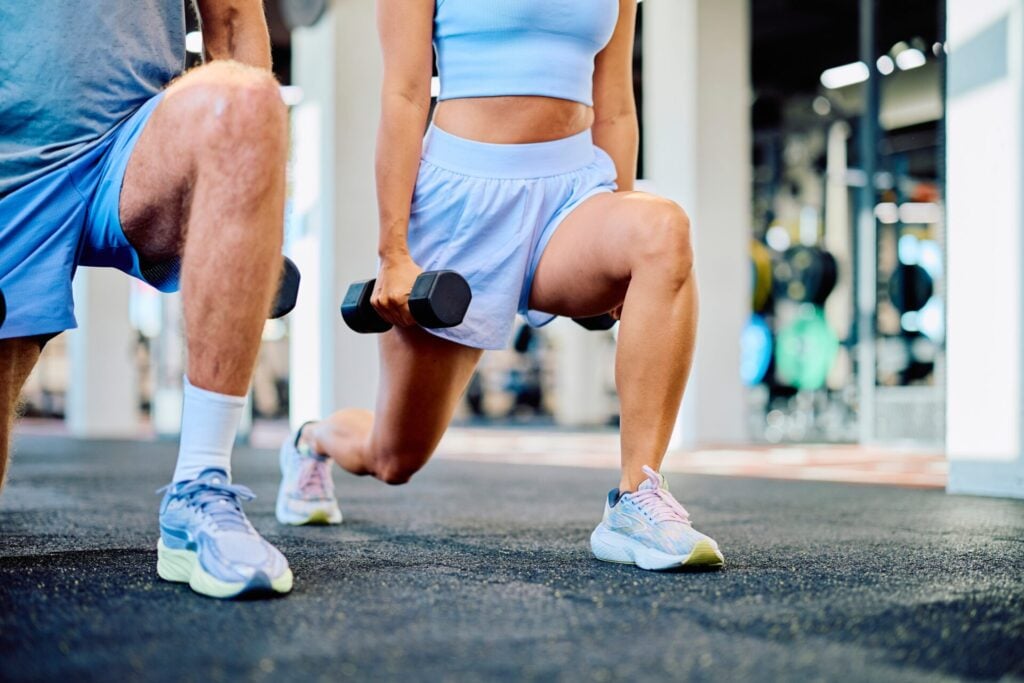
Bulgarian split squats are one of the best ways to build a bigger butt for men who have strength imbalances between their left and right sides, which is almost everyone. By training one leg at a time, you force each glute to do its share of the work without the stronger side compensating.
Set up with your rear foot elevated on a bench behind you, and lower your body until your front thigh is at or below parallel. Keep your torso upright or lean slightly forward to increase glute engagement. Three sets of 8 to 10 reps per leg with dumbbells is a solid starting point. These are humbling: most guys need to drop their ego and use lighter weight than expected.
Step-ups on a high box (16 to 20 inches) work similarly. The higher the box, the greater the hip flexion at the bottom, which means more glute stretch and activation. Drive through your heel on the working leg and avoid pushing off with the back foot.
Glute Medius Isolation with Lateral Movements
The glute medius responds well to lateral and rotational work. Banded lateral walks, clamshells, and cable hip abductions are all effective options. These aren’t glamorous exercises, and you won’t be posting them on social media, but they build the upper-outer portion of the glute that creates width and roundness.
Try this as a warm-up or finisher:
- Place a resistance band just above your knees
- Perform 15 to 20 lateral walks in each direction, keeping tension on the band throughout
- Follow immediately with 15 banded clamshells per side
- Repeat for 2 to 3 rounds
Cable hip abductions (standing, pulling one leg away from the body against cable resistance) are another excellent choice. Use moderate weight and focus on controlled reps rather than swinging. Two to three sets of 12 to 15 reps per side, performed twice per week, will make a noticeable difference within a couple of months.
Nutrition and Hypertrophy Strategy
Training is only half the equation. You can run the most well-designed glute program on the planet, but if your nutrition doesn’t support muscle growth, you’ll be spinning your wheels. Muscles need raw materials to grow, and that means eating enough of the right things.
Calculating Protein and Caloric Surplus for Growth
Building muscle requires a caloric surplus: you need to eat more calories than you burn. For most men, a surplus of 250 to 500 calories above maintenance is the sweet spot. This provides enough energy for muscle growth without excessive fat gain. You can estimate your maintenance calories by multiplying your bodyweight in pounds by 14 to 16, depending on activity level.
Protein is the most critical macronutrient for hypertrophy. Current research supports consuming 0.7 to 1.0 grams of protein per pound of bodyweight daily. For a 180-pound man, that’s 126 to 180 grams of protein spread across 3 to 5 meals. Good sources include chicken breast, lean beef, eggs, Greek yogurt, fish, and whey protein.
Carbohydrates matter too. They fuel your training sessions and support recovery. Aim for 1.5 to 2.5 grams of carbs per pound of bodyweight, with higher-carb meals around your training window. Don’t fear fats either: keep them at 0.3 to 0.5 grams per pound to support hormone production, including the testosterone that drives muscle growth.
Supplements to Support Muscle Recovery
Supplements aren’t magic, but a few have solid evidence behind them. Creatine monohydrate is the most well-researched sports supplement in existence. Taking 3 to 5 grams daily increases your muscles’ phosphocreatine stores, allowing you to push harder during sets and recover faster between them. It’s cheap, safe, and effective.
Whey protein powder is a convenient way to hit your daily protein target, especially on busy days. It’s not superior to whole food protein, but it’s faster to prepare and easier to consume post-workout. A good multivitamin can fill nutritional gaps, and vitamin D supplementation (2,000 to 5,000 IU daily) is worth considering if you spend most of your time indoors, since deficiency is linked to impaired muscle function.
Skip the fat burners, testosterone boosters, and anything promising overnight results. If a supplement sounds too good to be true, it is.
Optimizing Recovery and Training Frequency
How you recover between sessions determines how quickly your glutes grow. Training provides the stimulus, but growth happens during rest. Get this wrong and you’ll plateau, or worse, regress.
Implementing Progressive Overload Safely
Progressive overload is the principle of gradually increasing the demands placed on your muscles over time. Without it, your body has no reason to adapt and grow. The simplest way to apply it is by adding small amounts of weight each week: 5 pounds on compound lifts and 2.5 pounds on accessories.
But weight isn’t the only variable you can progress. Here are other effective methods:
- Adding 1 to 2 reps per set at the same weight before increasing load
- Increasing total sets from 3 to 4 per exercise over a training block
- Slowing the eccentric (lowering) phase to increase time under tension
- Decreasing rest periods between sets to increase metabolic stress
A practical approach is to train glutes twice per week: one heavy day focused on compound lifts (hip thrusts, squats, deadlifts) in the 5 to 8 rep range, and one moderate day focused on accessories and isolation work in the 10 to 15 rep range. This gives you both mechanical tension and metabolic stress, the two primary drivers of hypertrophy.
Track your workouts in a notebook or app. If you’re not recording your sets, reps, and weights, you’re guessing. And guessing doesn’t build muscle.
The Importance of Rest Days and Sleep
Your glutes need 48 to 72 hours between direct training sessions to fully recover. Training them three or more times per week might sound productive, but it often leads to accumulated fatigue that blunts growth. Twice per week with at least two days between sessions is the frequency supported by most hypertrophy research.
Sleep is where the real magic happens. During deep sleep, your body releases growth hormone and testosterone, both critical for muscle repair and growth. Aim for 7 to 9 hours per night. A 2023 study in the Journal of Strength and Conditioning Research found that athletes sleeping fewer than 6 hours per night experienced 60% less muscle protein synthesis compared to those sleeping 8 hours. That’s not a small difference.
If sleep quality is an issue, keep your room cool (65 to 68 degrees Fahrenheit), avoid screens for 30 minutes before bed, and keep a consistent sleep schedule even on weekends. These simple habits compound over time and make a measurable difference in your training results.
Building Your Bigger Butt: Putting It All Together
Growing your glutes as a man comes down to a handful of non-negotiable principles: train them with heavy compound movements twice per week, add targeted accessory work for shape and balance, eat enough protein and calories to fuel growth, and recover properly between sessions. None of this is complicated, but it does require consistency over months, not weeks.
Start with hip thrusts, deep squats, and RDLs as your foundation. Layer in Bulgarian split squats and banded lateral work for symmetry. Eat 0.7 to 1.0 grams of protein per pound of bodyweight, sleep 7 to 9 hours, and track your progressive overload. If you do these things consistently for 12 to 16 weeks, you will see results: period.
The guys who build impressive glutes aren’t doing anything secret. They’re just doing the basics with discipline and patience. Pick a program, commit to it, and let the work speak for itself.