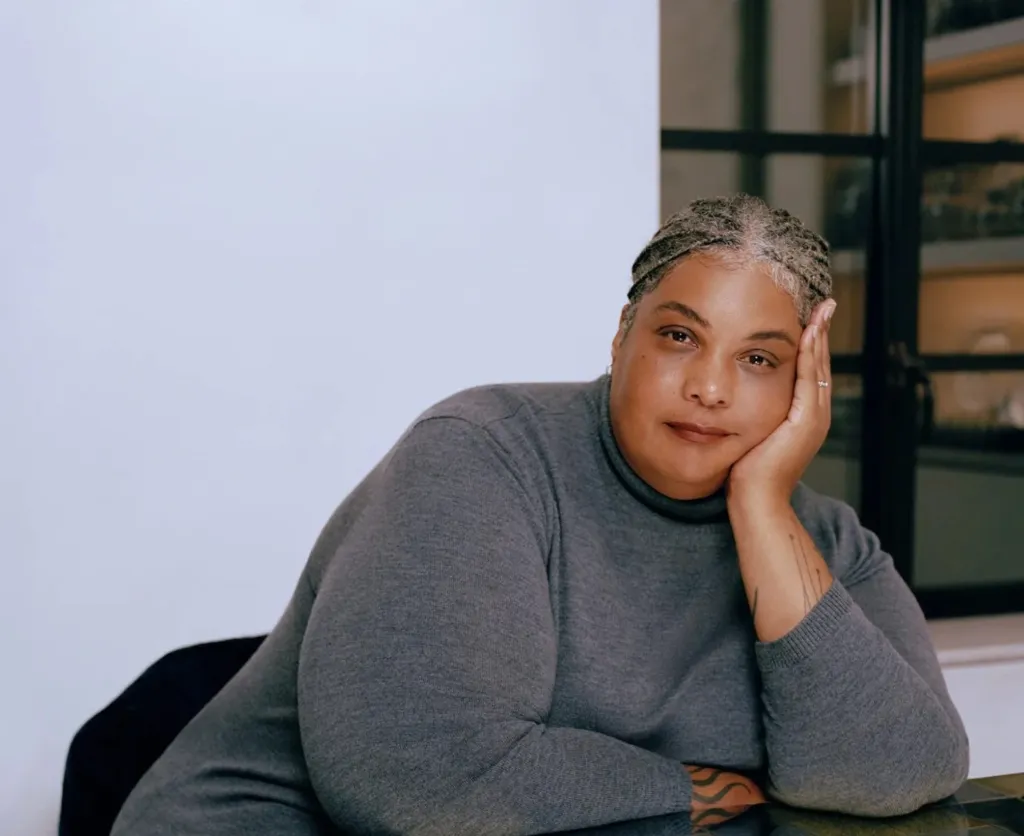
For more than two decades, Roxane Gay has challenged readers to think deeper, question harder, and confront the uncomfortable truths that shape our lives.
Through bestselling books like Bad Feminist, Hunger, and Difficult Women, the writer, cultural critic, professor, and public intellectual has become one of the most influential literary voices of her generation.
Whether examining race, gender, politics, relationships, or the complexities of modern identity, Gay’s work has consistently pushed conversations forward while creating space for perspectives that have too often been overlooked.
Now, she’s bringing that same fearless approach to one of independent publishing’s most beloved literary institutions.
One year after acquiring The Rumpus alongside celebrated designer, author, and Design Matters host Debbie Millman, the author is helping usher the publication into a bold new era.
Founded in 2009, The Rumpus built its reputation as a home for emerging writers, deeply personal essays, boundary-pushing criticism, and stories that didn’t always fit within traditional publishing spaces.
Under Gay and Millman’s stewardship, the magazine is doubling down on that mission while expanding its reach, modernizing its platform, and creating new opportunities for readers and writers to connect beyond the screen.
The relaunch arrives at a pivotal moment for literary culture. As independent media outlets continue navigating an increasingly crowded digital landscape, The Rumpus is positioning itself as something more than a publication.
Through a refreshed visual identity, expanded community programming, and initiatives like the inaugural Rumpus Pride 30, the magazine aims to foster meaningful cultural dialogue while championing the next generation of storytellers.
For Gay, the mission remains rooted in what literature has always done best: bringing people together through honesty, vulnerability, and imagination.
“Literature creates connection, empathy, and possibility,” the writer says.
“The Rumpus has long been a space where writers can take risks and readers can encounter perspectives that move them. Debbie and I are honored to steward the publication into its next era where the most vital voices of our time don’t just exist, but they thrive and lead the conversation.”
As The Rumpus enters its next chapter, Gay and Millman aren’t simply preserving a literary legacy, they’re actively reimagining what an independent literary community can look like in 2026 and beyond.
So.Gay caught up with the storyteller to speak on the publication’s direction, the evolution of storytelling, and more.
So. Gay: You’ve spent much of your career challenging institutions from the outside, publishing, academia, media, and culture. With The Rumpus, you’re now helping lead one. How do you preserve the rebellious spirit of a platform once you become responsible for its future?
Gay: That’s a great question. My wife, Debbie and I, who brought the publication last year – we’re figuring it out as we go. We’re very committed to the rebellious nature of the site. The site has always been independent. It has always prioritized work from every writer that is talented and has something to say. We make an effort to ensure that the work is as diverse as possible, not only in terms of demographics, but in terms of aesthetic. We;re also trying to figure out how to sustain and continue to build the Rumpus audience. We have a very robust subscriber base. They’re loyal, and so I appreciate that. We’re never going to do anything that compromises our ethos. The only thing we prioritize at this point is being able to pay writers well, because for so long, the magazine hasn’t been able to pay writers or pay them a well intended but small amount of money for their work. We just want to make sure that money flows to the writer, as it always should.
So. Gay: We’ve spent the last decade watching algorithms decide what gets amplified and what gets ignored. What’s a voice, perspective, or type of story you think we’re in danger of losing if editors stop making human-centered decisions?
Gay: We’re in danger of losing authenticity. We’re in danger of hearing from people on the margins who already have to struggle to be seen and heard. I think that we’re particularly in danger of no longer hearing from people like Palestinians and trans people who are fighting as hard as they ever have. Life shouldn’t have to be a constant fight. You shouldn’t have to be constantly in the position of establishing your humanity. The Trump administration is working overtime to move our voices further to the margin. We have to resist even more intensely.
So. Gay: You mentioned The Rumpus remaining committed to risk-taking voices. What does a risky writer look like in 2026? Has that definition changed from when you first entered the literary world?
Gay: I think it has changed in some ways, but it’s also very much the same. It’s people who are willing to challenge authority and challenge power and challenge the status quo. It’s people who know that they might be saying the difficult thing to an audience who prefers comfort and who prefers ease. Hopefully, writers will continue to do this important work of testing the margins.I also try to never lose sight of the importance of craft for us and so many amazing writers. It’s a great time to be a writer.
So. Gay: The inaugural Pride 30 looks backward and forward at the same time, celebrating established voices while introducing readers to new ones. When you think about queer literary legacy, what’s something today’s generation understands better than previous generations, and what’s something you hope they don’t lose?
Gay: I think younger, and I mean younger in the sense of newer to the writing craft and to publishing writers, they understand – I think people my age and older did a lot of really important work so that the younger generation understands that they have every right to use their voice, and they have every right to use their voice in however, whatever way they see fit. I think that queer writers in particular have always had this belief, because queer writing is nothing new. There are fewer and fewer gatekeepers, and there are more and more opportunities.
So. Gay: You’ve written extensively about hunger, desire, ambition, identity, and the things we carry. When you look at the stories people are telling right now, what emotional subject do you think we’re still struggling to write honestly about?
Gay: This is such a great question, Ty. I think that a lot of people still struggle to write about family and how they’re treated in complex family dynamics because not everyone is embraced for being LGBTQ to this day, which stuns me, but here we are. I think a lot of times people don’t know how to write about that and also retain those relationships, even when those relationships are harmful and toxic. I think most people want to be loved and accepted by their family of birth. It’s ideal. That love shouldn’t come at a cost. I think a lot of people struggle with, how do I write about that cost? How do I be honest about the ways in which the people who are supposed to love me most don’t, or love me conditionally? They’re doing the writing and they’re doing amazing writing on it. I do think it’s still hard to write about, like living in a human body and making choices with your body that other people may or may not agree with.